Saint-Émilion
Château Canon
Château Canon
B.P. n°22 – 33 330 Saint-Émilion
Tél: 05.57.55.23.45 Fax: 05.57.24.68.00
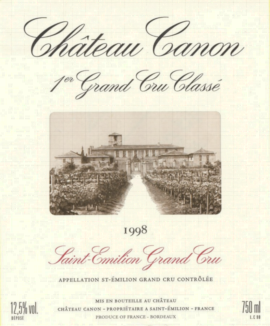
Château Canon
Saint-Émilion Location: Château Canon is located on the plateau in the middle of the Saint-Émilion appellation. It is Southwest of the town of St-Émilion.Size: Château Canon has just under 55 acres (22 hectares) of vineyards. As of 2002, 42 acres (17 hectares) were in production with 7 acres (3 hectares) in the first year of production.Classification: 1er Grand Cru Classé B in Saint-Émilion
Vineyards: Château Canon’s vineyards are on a plateau of clay with a deep limestone subsoil. The vineyards have a very favorable exposure to the south/southwest. A southern exposure means more hours of sun and better ripening of the grapes. The vineyards are planted with a density of 2225 plants per acre (5500 per hectare). Château Canon’s vines average 25 years of age. As is the practice in Bordeaux, the pruning method at Château Canon is the Double Guyot method.
Château Canon’s vineyard management practices include leaf thinning to gain greater exposure of the sun’s rays on the hanging grape clusters. Another part of the regimen is the practice of ‘green harvesting’ to remove excess bunches of grapes before they can ripen. Green Harvesting reduces the amount of grapes that a vine produces but improves the quality and intensity of the fruit that remains. Harvesting of grapes is done by hand as required by AOC regulations. The average yield at Château Canon is 30 hectolitres per hectare but it can vary widely. The yield in 2002 was 21 hectolitres per hectare.
Grape Varieties: Château Canon makes red wine. The vineyards at Château Canon are planted with 75% Merlot and 25% Cabernet Franc using rootstocks 420 A and 41 B. The percentage of each grape variety used in the final blend will usually vary from vintage to vintage. In the 2002 Château Canon, the actual final blend was 90% Merlot and 10% Cabernet Franc.
Winemaking:
Once the grapes have been harvested, they are are put through a rigorous sorting and selection process before they make it into the winery. This insures that only grapes of the very highest quality are used to make Château Canon. After sorting, the grapes are destemmed and then undergo one more inspection before the winemaking begins.
Fermentation takes place in temperature controlled oak vats. There are various sizes of vats available to the winemaker. The alcoholic fermentation lasts 8 days followed by 10 to 15 days of maceration. The skins and juice (the “must”) are in contact during this period. The skins of the grapes float to the top of the vat and form a ‘cap’. The liquid in the tank is pumped over the cap of skins twice a day. The cap is also broken up when it is punched down into liquid once daily. Both of these techniques are important because they cause more of the components from the skins to transfer into the wine. As a result, the color is deeper and the wines are more flavorful. The temperature in the tanks is kept between 29 degrees Celsius and 32 degrees Celsius. Once the alcoholic fermentation and maceration period is complete, the wines are moved to stainless steel tanks to undergo malolactic fermentation. Near the end of November, they are placed in oak barrels for aging.
Château Canon’s wines are aged in oak barrels for 18 to 20 months. 50 to 70% of the barrels used each year are new, depending on the quality and needs of the vintage. The wines are racked into clean barrels every 3 months as part of a process that removes sediments from the wine. Six months before bottling, the wines are ‘fined’ using fresh egg whites in the barrels. The decision on the final blend takes place in March. Finally the wines are bottled without filtering.
History: Château Canon owes its name to Jacques Kanon, who purchased the property in 1760. Kanon instituted improvements in the already existing Saint Martin vineyards that elevated the quality of the wine as well as the reputation of the estate. Just ten years later, in 1770, Château Canon was sold to Raymond Fontemoing, an important wine shipper from Libourne.
Château Canon was purchased by Monsieur and Madame Fournier in 1919. The Fournier’s brought a wealth of experience to Canon. Their dedication to quality ultimately carried over to their grand-children. Château Canon was most recently purchased in 1996. The new owners are the Wertheimer family, who also own Chanel.
Style: Château Canon is a powerful wine that gains complexity and finesse with age. This is a wine that will reward you richly for a few years of proper cellaring.Second Wine: Château Canon also makes a second wine called Clos Canon. This wine has the same basic makeup as Château Canon but cannot match the complexity, depth of flavors and aging potential of the Grand Vin. Clos Canon accounts for about 40% of the entire production of the Château. Clos Canon is aged entirely in one year old oak barrels.
Special thanks to Béatrice Amadieu for her assistance with the information about Château Canon.